The Two-Minute Pause That Makes a Priority Visible
A two-minute priority pause turns a jumble of urgent-feeling demands into a short, visible choice, so you can pick a useful next task without overplanning.
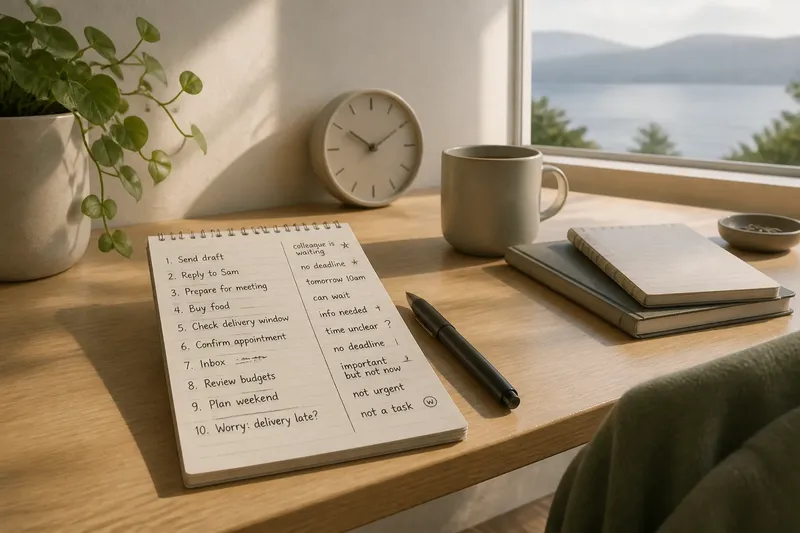
A two-minute priority pause can stop the loudest demand from automatically becoming your next task. Before replying to the latest message or opening another tab, write down what is asking for attention; the short list makes it easier to distinguish urgency from importance.
This is not a plan for the whole day. It is a small decision aid for moments when several things seem to need doing and your attention is already divided. The pause works best when it ends with one reasonable next task, not a beautifully organised record of every obligation you have ever acquired.
1. Put the current demands where you can see them
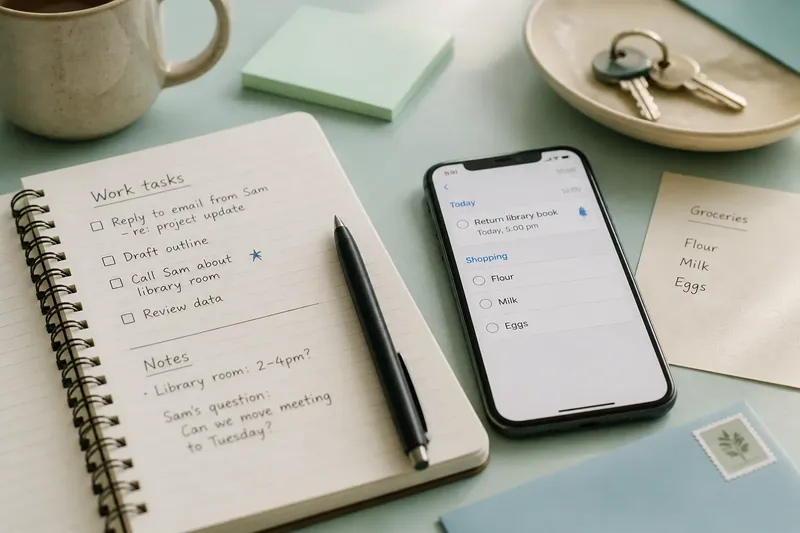
Take a scrap of paper, a blank note on your phone or a small whiteboard. Set a brief timer if that helps you stop writing. List the demands currently occupying your mind, using plain phrases: “reply to Sam”, “send the draft”, “buy food”, “prepare for the meeting”.
Keep each item separate. “Sort out work” is too broad to compare with “send the draft”; it hides the action inside a fog of general responsibility. If a demand contains several distinct tasks, split it only enough to make its next action recognisable.
Include worries that are not yet tasks, but mark them as such. “I’m worried the delivery will be late” is different from “check the delivery window”. The first describes a feeling; the second is an action you could actually take. This distinction prevents unease from masquerading as a deadline.
2. Separate a real deadline from an urgent feeling
For each item, ask what makes it feel pressing. Is there a time by which someone needs a response, a scheduled commitment, or a consequence that changes if you wait? Or is the task simply visible, recent or attached to an insistent notification?
A message can sound urgent without requiring an immediate answer. Conversely, a quiet task may have a fixed deadline that is easy to overlook. If the timing is unclear, look for the information that would settle it: a calendar entry, the original request, or a direct question to the person involved. Do not promote a task to emergency status merely because it has arrived with a subject line in capitals.
This check is about the next decision, not judging the person who made the request. You may decide to respond quickly because another person is blocked, but that is a reason you can name rather than a reflex produced by the notification.
3. Compare consequences, not noise
Once the list is visible, compare what happens if each item waits. A task is more likely to deserve priority when delaying it would obstruct someone, make a later task harder, or allow a meaningful opportunity to pass. A task can be important without being due this minute; it may still deserve a place ahead of a fresh but low-consequence request.
Keep the comparison proportionate. You are not trying to calculate a perfect score for every item. Think of the list like keys on a table: putting them side by side makes the one you need easier to spot, but it does not turn the table into a navigation system.
Say you have a draft to send before a colleague can finish a decision, a general inbox to clear, and a household item to buy later. Imagine the colleague’s decision is waiting on that draft, while the inbox has no known deadline and the household item can wait until you leave. Sending the draft is a plausible next choice because its delay affects another task; the inbox merely feels prominent. If the colleague is not actually waiting, the comparison may change. The point is to use the consequences you can establish, not to treat the first impression as fact.
4. Choose a next task that fits the available stretch
Importance alone does not determine what you can do now. Consider the time and attention you have before your next commitment, and choose an action that fits. If you have only a short gap, sending a clear acknowledgement or gathering the document needed for a larger task may be more suitable than beginning work you cannot leave in a sensible state.
That does not mean every small task should outrank substantial work. It means the next action should be both worthwhile and feasible. If the important task needs quiet concentration and you have a noisy, interrupted stretch, you might protect a suitable later window and use this one for a necessary, bounded action.
When a task is too large to begin, name its first useful move: open the relevant file, identify the question that needs answering, or ask for the missing information. Keep the move connected to the larger priority. Otherwise, “getting started” can become a polished detour.
5. Make the choice explicit and let the rest wait
Mark one item as the next task and write a short reason beside it: “send draft; colleague is waiting” or “confirm appointment; time is unclear”. This gives the choice a visible basis. If circumstances change, you can reconsider the reason instead of re-running the entire debate from scratch.
Leave the other items on the list without treating them as promises to complete everything. If one needs a response now, send a brief note that gives a realistic expectation. If another is important but not immediate, give it a distinct next action or a suitable time to return to it. A list can hold a demand without making it the current demand.
When the chosen task is complete, pause long enough to see whether the situation has changed. A new deadline or a blocked colleague may alter the order; a fresh notification on its own need not. The two-minute priority pause is useful because it makes a decision visible, not because it makes the rest of the day obey it.
Questions that help make the choice?
How do I know whether something is genuinely urgent?
Look for a clear time limit or a consequence that worsens if you wait, rather than relying on tone or recency. If the timing is uncertain, check the request or ask the person who depends on it.
What if two tasks seem equally important?
Choose the one whose delay blocks more work or affects someone else first, if that consequence is clear. If neither has an obvious edge, select the task that fits your available attention and revisit the other when that stretch ends.
Should I include personal tasks on the list?
Yes, if they are competing for attention or have a real consequence if delayed. Keep them in the same plain language as work tasks so they can be compared on timing, impact and feasibility rather than on which category seems more deserving.
What if the pause takes longer than two minutes?
Stop when you have enough information to choose one sensible next action. If a task needs more investigation, make that investigation the next action rather than extending the list into a substitute for doing the work.
Use the two-minute priority pause when urgency starts to feel like a single undifferentiated demand. A short list and one stated reason can give you a clearer next move; the useful result is not certainty, but a choice you can explain and adjust.