Why the To-Do List Became a Familiar Tool
Why the to-do list became familiar: learn how different writing tools shaped reminders and choose a format that keeps your next action easy to find.
A to-do list became familiar because it gives a future action somewhere to wait besides your memory. The history of the to-do list is not a straight march from scraps of paper to phone apps; it is a series of practical choices about where a reminder can live and how easily it can be found again.
People have recorded obligations and intended work in many settings. But an account of goods, a household note and a personal task list are not interchangeable. Their shared feature is modest: each puts information outside the mind that might otherwise have to retain it.
The useful question is not which format is newest. It is what the reminder must do, and which surface makes that easiest without adding unnecessary work.
Writing surfaces served different purposes
In some settings, people used writing to track stores, labour, exchanges or correspondence. Clay and wax tablets, among other materials, served particular administrative and practical needs. Those records could include future obligations, but it would be misleading to treat them all as personal to-do lists in the modern sense.
A record of goods due for delivery belongs to a wider arrangement involving people and work. A personal list gathers actions for one person to consult. The boundary can blur: household duties, paid work and shared errands may all end up on the same page.
Different materials made different kinds of recording possible. Wax could be revised; a loose piece of paper could be made quickly but was easy to lose; a bound notebook kept notes together but had to be carried. These are practical distinctions, not evidence that one material was universally preferred.
Each option had a trade-off. A reusable surface suited notes that might change. Paper could keep a thought without much preparation, while a notebook offered continuity. None of them solved the separate problem of remembering to check the reminder.
Paper made intentions visible and revisable
A piece of paper can sit beside the work it refers to. Someone preparing a meal might jot down ingredients; a clerk might write tasks beside correspondence; a household might keep an errands note. These are simple examples of how a written reminder can be placed near the activity, not claims about how often people used a particular practice.
Paper also leaves changes in view. Crossing out a completed task shows that it has moved on; copying a postponed one makes its continued presence visible. The page can become crowded, though. A list records not only intentions but also the things that remain unfinished. Paper is a patient witness, sometimes more patient than its owner would prefer.
Pre-ruled forms and office stationery offered layouts with spaces for dates, tasks or completion marks. Such layouts can make similar records easier to organise within a workplace, but their effect depends on the setting and the people using them. A blank sheet, meanwhile, asks for no categories in advance.
Keeping a note near where it will be used can shorten the distance between reminder and action. A shopping note carried to a shop and a work list kept beside a desk serve different situations. Neither makes the task happen by itself; each simply makes the prompt available in a particular place.
A notebook keeps task context close
A notebook gives tasks a stable home and lets them sit beside relevant notes, a phone number or the reason something needs doing. “Call Sam” may be clear when the context is fresh; “Call Sam about the library room” is easier to interpret later.
Notebooks also suit people who like to think on paper. A task can be annotated, moved to another section or split into smaller actions without opening an app. Handwriting may encourage a more deliberate wording, but there is no single writing style that works for everyone.
The limitations are equally ordinary. A notebook can be left on a desk, put in the wrong bag or opened to an out-of-date page. Older tasks may remain visible long after they are useful. For a task tied to a particular time, a notebook entry is easy to miss unless you deliberately return to the page.
A notebook is a reasonable fit when tasks benefit from context and you already have a habit of checking it. It is a weaker fit when reminders need to arrive at specific times or your day moves between locations.
Digital notes move with the device
A phone or computer can capture a task away from a desk, then let you edit, search or share it. A notes app can hold general reminders; a calendar or reminder app can attach an alert to a time. These functions bring recording and prompting together, although they may live in separate applications.
That convenience depends on knowing where the task went. A reminder saved in a message, another in email and a third in a list app can be harder to retrieve than one note on paper. Search helps only if you recall enough of the wording and know where to search.
Notifications suit tasks that genuinely depend on timing. If every item triggers an alert, however, the phone becomes a determined but indiscriminate clerk. Keep timed prompts for actions that need them; leave flexible tasks in a list you can review when convenient.
Digital notes suit people who carry a device, need to share or revise tasks, or want time-based prompts. Paper may suit someone who prefers a visible page without another stream of alerts, or who does not want to manage reminders across several apps.
Choose a to-do list format by the job it does
You do not have to use one medium for every task. Put the reminder where it can do its particular job: a shopping note on the phone you take to the shop, a detailed work task beside its context, or an appointment in a calendar that can show its time.
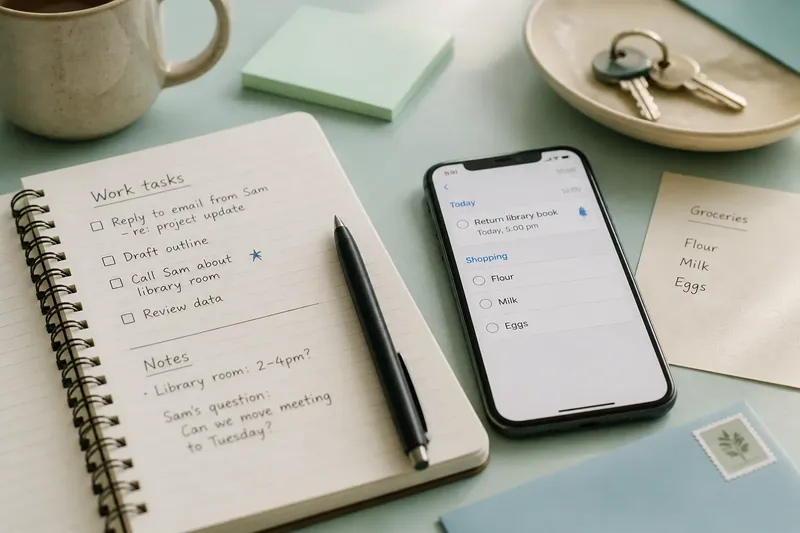
Say you need to return a library book, reply to a colleague and collect flour on the way home. The starting inputs are three tasks: one needs a due-time prompt, one needs the colleague’s question for context, and one depends on passing a shop. Put the return in a timed phone reminder, the reply in a notebook with the question beside it, and the flour on a phone shopping note. The expected result is that each action appears in a place suited to its condition; the trade-off is checking both the notebook and phone rather than relying on one list.
For a simpler choice, check what each reminder needs:
- Context: Check whether the task needs a name, reason or detail beside it. If it does, use a notebook or paper page; if it does not, keep it on a short list.
- Visibility: Check whether seeing the task where you work would prompt action. If so, keep a paper list there; if not, use the place you already check.
- Portability: Check whether the task may arise away from your desk. If so, use a phone note you can find; if not, a desk list may be enough.
- Timing: Check whether the action depends on a specific time. If it does, use a calendar or timed reminder; if it does not, leave it on an untimed list.
- Sharing: Check whether another person needs to update the same task. If so, agree on a shared digital list or record; if not, keep it in your own system.
- Alerts: Check whether missing a prompt would matter more than receiving another notification. If it would, set an alert; if not, keep the task on a list and review it when suitable.
For a product’s specific features or settings, follow its instructions. The practical test is simpler: can you find the reminder when needed, and does it tell you enough to act?
What readers ask about the to-do list?
Why did people start writing personal task lists?
Writing things down lets an obligation remain available after the moment it occurs. Historical records served many purposes, so not every written list was personal in the present-day sense.
Are paper lists better than digital lists?
Neither is inherently better. Paper can keep a task beside its context without alerts, while digital lists can be searched, shared or connected to timed prompts; the useful choice depends on the reminder’s job.
What belongs on a to-do list?
Include actions you want to remember and phrase them so the next move is clear. Add context when it would prevent confusion, and use a calendar for something tied to an appointment time.
How did phones change personal reminders?
Phones brought portable notes, editing and alerts onto a device many people carry. They also made it easy to spread tasks across apps, which makes a consistent place to check useful.
The history of the to-do list is less a march towards a perfect tool than a succession of ways to put a thought within reach. A notebook is like a drawer: useful when its contents have a known place, less so when every small object goes in at random. Choose the to-do list format that makes the next action easy to find and gives it enough context; the reminder is doing its job when memory has less to carry.